


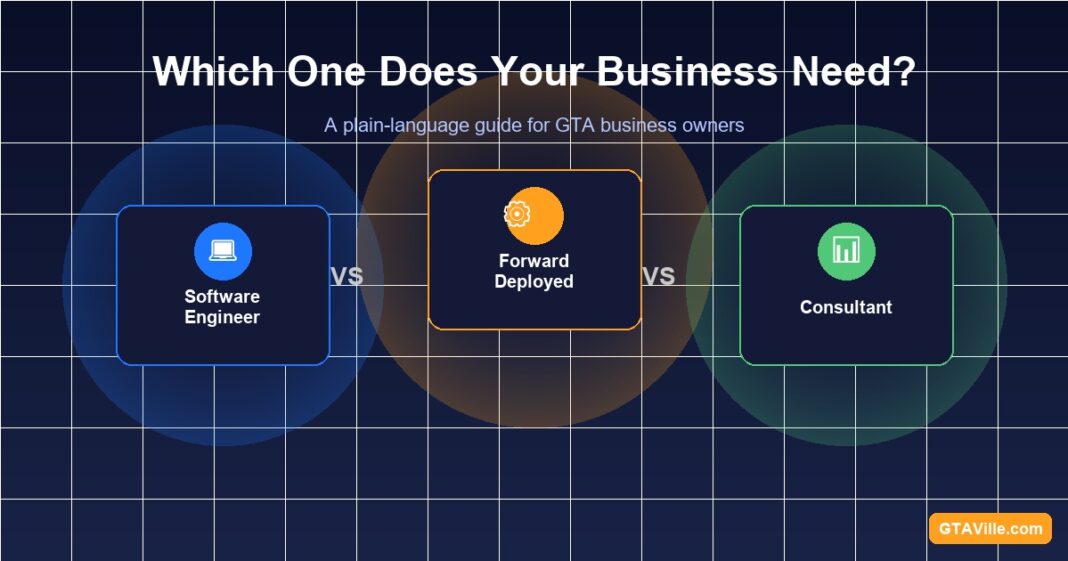
Software Engineer vs. Forward Deployed Engineer vs. Consultant: Which One Does Your GTA Business Actually Need?
If you’re a business owner in the Greater Toronto Area trying to fix something with technology — a slow process, a pile of manual work, a system that doesn’t talk to another system — you’ve probably searched some version of “hire a developer” and ended up more confused than when you started.
Should you hire a software engineer? Bring in a consultant? Or is there something called a “forward deployed engineer” that actually fits what you need? These three roles sound similar but they solve very different problems. Picking the wrong one is expensive.
Here’s a plain-language breakdown so you can make the right call before spending a dollar.
What a Software Engineer Does
A software engineer builds software. You give them a spec — a clear description of what you want — and they turn it into working code. Good ones push back on bad specs and care about quality, speed, and security.
The key word is spec. A software engineer works best when you already know what you want built. A booking page with a clear design. An integration between your POS and your accounting software. A fix to a slow report.
They don’t usually need to spend time learning how your business runs day-to-day. Their job is to take a defined task and execute it well. If your problem fits on a clear ticket, a software engineer is probably the right hire — and often the most affordable one.
Best when: You know exactly what you want built and it doesn’t depend on deeply understanding your operations.
Main risk: They build the wrong thing perfectly. If the spec was off, the code will be too.
What a Forward Deployed Engineer Does
This title comes from Palantir, the data software company. Their version of the role involves embedding engineers directly inside clients’ businesses — not just writing code, but learning how the business actually runs and building inside the real systems.
In practical terms, a forward deployed engineer (FDE) does two things a regular developer doesn’t: they spend real time understanding your operations (not just reading a brief), and they build inside your actual tools — your CRM, your booking system, your spreadsheets, your WhatsApp inbox.
The questions are different. A software engineer asks “what should the button do?” An FDE asks “who presses it, what were they doing just before, and what happens when they press it wrong?” Then they write the code too.
A GTA example: Imagine a multi-location GTA health clinic where front desk staff copy patient intake information manually between the scheduling system and the billing software every single day. A software engineer could build a sync tool — but only if you’ve already figured out exactly what data moves where and in what format. An FDE would sit with your front desk team for a few days, understand the actual flow including all the edge cases nobody wrote down, and then build something that works in practice, not just in theory.
This is also why AI agents often need FDE-style work. An AI that answers customer questions is only useful if it’s connected to your real inventory, pricing, and calendar — and has guardrails. That kind of project requires someone who understands your operations, not just someone who can write a chatbot.
Best when: You know something is broken or slow but you can’t clearly describe the fix — and the problem is tangled up in how your team actually works.
Main risk: Can be overkill for a simple, clearly defined task. You’re paying for discovery you don’t need.
What a Consultant Does
A consultant gives you advice. They study your business, talk to your people, compare you with what they’ve seen elsewhere, and tell you what to do. Good consultants are excellent at strategy, pricing, restructuring, vendor selection, and spotting problems you can’t see from the inside.
The limitation is clear: most consultants don’t build. You get a plan, a report, or a recommendation — then you need someone else to make it real. That handover is where value leaks. The person who understood the problem leaves, and the person who builds the solution never met your staff.
That’s not a knock on consultants. Sometimes advice is exactly what you need. If you’re a GTA restaurant owner deciding whether to open a second location, or a retailer deciding whether to launch an online store, or a service business evaluating whether to switch platforms — you want clear strategic guidance first, not code.
Best when: You need a decision, not software. The question is strategic: should we do this? How should we price it? Which vendor fits us best?
Main risk: The plan never gets built, or gets handed to someone who builds it wrong because they weren’t in the room when it was designed.
Side by Side
| Software Engineer | Forward Deployed Engineer | Consultant | |
|---|---|---|---|
| Main output | Working code for a defined task | Working systems built inside your business | Advice, plans, and recommendations |
| Starts from | A spec, ticket, or roadmap | Your messy real problem | Your goals and questions |
| Time with your team | Low | High, especially early on | Medium — interviews and workshops |
| Writes code | Yes | Yes | Usually not |
| Owns the result | Sometimes | Yes, and keeps improving it | No |
| Best when | You know exactly what to build | You know the pain, not the fix | You need a decision, not software |
| Main risk | Builds the wrong thing well | Overkill for simple, clear tasks | Plan never gets built, or built wrong |
Which One Should You Hire?
Here’s a simple test.
If what you need is a decision — should we expand? which platform should we use? is this market viable? — hire a consultant. Software won’t answer strategic questions.
If you can write down exactly what you want and it doesn’t require deep knowledge of your daily operations, hire a software engineer. It’ll usually be faster and more affordable. That’s the right choice for plenty of GTA small businesses.
If you know something is broken but you can’t describe the fix — and the problem lives inside your operations — that’s forward deployed work. Classic examples in GTA businesses:
- Staff manually re-entering orders between a POS system and a delivery platform
- Customer inquiries piling up overnight with no consistent follow-up process
- A booking flow that works in the office but breaks for clients on mobile
- Franchises using different spreadsheets to track inventory because no one centralized it
These problems need someone who understands the operational reality and then builds the fix. That combination — deep context plus the ability to ship — is the FDE’s value.
Frequently Asked Questions
Is a forward deployed engineer just a consultant who codes?
Close, but not quite. A consultant’s job typically ends at the recommendation. A forward deployed engineer’s job ends when the thing works in production and your team is actually using it. The building is the point, not a bonus.
Do I need someone on-site?
Not always. What matters is access — to your real systems, your processes, and the people doing the work. That can happen through calls, screen shares, and time spent watching how your team operates day-to-day. Many GTA businesses work with remote technical talent across North America.
Is an FDE more expensive than a regular developer?
It depends entirely on the job. The better question is: what does the wrong hire cost? A cheaper developer who builds the wrong thing, or a plan that never ships, often costs far more than getting it right the first time.
Can one person do all three?
For a small GTA business, often yes. You’ll get some strategic thinking alongside the technical build. But for deep legal, tax, or financial advice, bring in a specialist. A good technical partner should tell you when you need one.
Not Sure Which One You Need? Start Here
If you’re unsure, that’s normal — and it’s actually a signal. If you could clearly describe your problem as a software ticket, you’d already have a developer hired. The fact that it’s fuzzy usually means you need someone who can sit with the problem first.
At GTAVille, we work with GTA businesses on technology, automation, and AI tools — and we’re happy to point you in the right direction even if the answer is “you need someone else for this.” Get in touch here and describe what’s going wrong. We’ll tell you honestly what kind of help makes sense.