



If you have been watching Greater Toronto Area real estate over the past five years, you have witnessed one of the most dramatic boom-bust cycles in Canadian history. Condo prices nearly doubled between 2019 and 2022. Then, almost overnight, sales collapsed to levels not seen since 1996. Record numbers of buildings were completed, cranes dominated the skyline — and yet units sat unsold, investors bled cash, and developers went into receivership. How did the most sought-after housing market in Canada end up in this position? And more importantly, what does it mean if you are a buyer, renter, or investor trying to navigate the GTA today?
This is Part 1 of GTAVille's four-part deep-dive into the GTA condo market — the most comprehensive analysis we have published. We will walk through five years of supply data, sales figures, and price movements, tell the story behind each number, and give you the context you need to understand what is really happening on the ground. Whether you are a first-time buyer trying to figure out if now is the right time, a tenant who has noticed rent going down, or an investor sitting on a condo that is costing you money every month — this series is for you.
We have drawn from data published by Urbanation (the leading GTA condo research firm), the Toronto Regional Real Estate Board (TRREB), CIBC Economics, TD Economics, and CMHC. Where we make forward-looking statements, we will tell you who said them and why. Let us start at the beginning: the pandemic.
The Pandemic Ignition: 2020 and 2021
How near-zero interest rates turned a brief freeze into a historic frenzy
When COVID-19 hit in March 2020, the GTA condo market briefly froze. Buyers stayed home, developers paused new launches, and the average resale condo price — which had been sitting at around $655,000 at the end of 2019 — slid to $610,000 through the year. For a moment, it looked like the correction that housing watchers had been predicting for years might finally arrive. It did not. What arrived instead was the exact opposite: the Bank of Canada cut its overnight rate to 0.25%, making borrowing essentially free. The result was a wave of demand that nobody in the industry had fully anticipated.
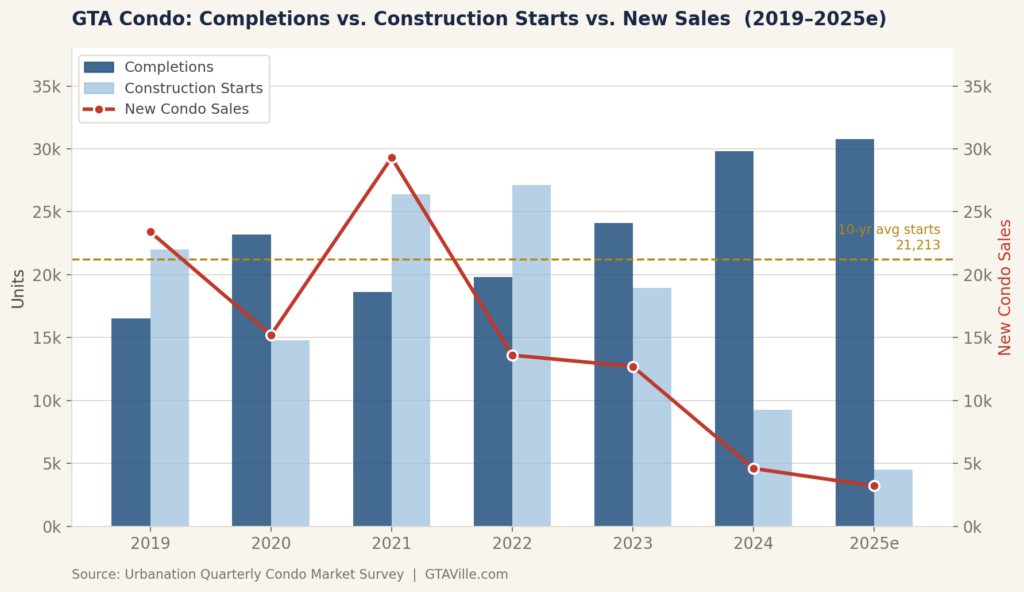
By 2021, the market had swung from pause to pandemonium. New condo sales across the GTHA hit a record 29,300 units — a number that had never been reached before in a single year. Developers launched project after project. Construction starts surged to 26,400 units. Average days on market fell to under 20, and in the hottest months of early 2022, some condos were changing hands in as few as 9 days. The average resale condo price climbed back above $710,000. Investors piled in, drawn by the combination of cheap debt and rapidly rising prices. The story told itself: buy now, because prices will only go up.
What few people were discussing loudly enough at the time was the lag built into this system. Those 26,400 construction starts in 2021 would take 3 to 4 years to become actual completed buildings. The seeds of 2024's oversupply were being planted in the optimism of 2021, and virtually nobody was paying close enough attention.
2021 BY THE NUMBERS

• 29,300 — New condo sales in 2021 (record high at the time)
• 26,400 — Construction starts in 2021 (the seeds of 2024's glut)
• $710,000 — Average resale condo price in 2021 (up from $610,000 in 2020)
The Peak and the Shock: 2022
Why 2022 was both the best and worst year in recent GTA condo history
The first quarter of 2022 was extraordinary by any measure. New condo launches were selling out within days. The average asking price for a new condo hit $1.62 million at the mid-year peak. Price per square foot for new builds surged by 18.9% in a single year — the largest annual jump ever recorded in the GTHA — reaching $1,541 per square foot on average across the region, and as high as $1,689 per square foot in parts of downtown Toronto. For context, that means a 700-square-foot one-bedroom was being priced at $1.15 million before closing costs and taxes. The year began with a sense that prices had completely decoupled from any rational affordability anchor.
Then, in March 2022, the Bank of Canada began raising interest rates. At first it felt like a minor recalibration — the kind of rate movement the market had absorbed before. But the Bank of Canada kept going: ten rate hikes in total, pushing the overnight rate from 0.25% all the way to 5.0% by mid-2023. This was a seismic shift for a market that had been underwritten by cheap debt. A buyer who could comfortably carry a $700,000 mortgage at a 1.5% rate was suddenly looking at a payment that was nearly double at a 5% rate. The math that had justified investor purchases — buy pre-construction, rent it out, coast on appreciation — stopped working almost overnight.
The impact on sales was immediate and dramatic. By the second half of 2022, new condo sales had crashed. Developers who had launched projects confidently in the spring were watching their absorption rates collapse. And critically, new construction starts — which had been running at peak levels through the first half of 2022 — continued at an elevated pace of 27,100 units for the full year, because those projects were already committed. The pipeline was full. The market had locked itself into a collision course between peak-era supply and a demand environment that was deteriorating rapidly.
Days on market for GTA condos averaged just 9 to 11 days in February and March 2022. By year-end they had stretched past 25 days — and they would reach nearly 40 days by 2024. The market that once demanded you make an offer on your lunch break became one where sellers waited six weeks for a serious bid.
The Supply Flood Meets the Demand Drought: 2023 and 2024
Record completions, collapsing sales, and an oversupply the GTA market has never seen before
This is where the 3 to 4 year construction lag came back to haunt the market. Every pre-construction unit sold in the frenzy of 2021 and early 2022 eventually needed to be built and completed. In 2023, a record 24,114 condo units were completed across the GTHA. In 2024, that record was shattered again: 29,800 completions — a figure that was 61% above the 10-year average, and 24% higher than the previous year's record. The cranes that had defined the GTA skyline for years were finally delivering their product. The problem? The market that had ordered all of it no longer existed.
New condo sales in 2024 totalled just 4,590 units across the GTHA — a 64% decline from 2023's already-depressed total of 12,696, and 78% below the 10-year average of 20,835 sales per year. To put that in perspective: in a market that historically absorbed roughly 20,000 to 25,000 new units per year, developers sold fewer than 5,000. This was the lowest annual total since 1996. At the same time, unsold new condo inventory accumulated rapidly — rising 58% over two years and reaching a record high of approximately 25,893 units by mid-2024. Factor in assignment listings and resale condos, and total unsold supply in the market approached 40,000 units. At the pace of sales in 2024, that would take over 50 months to absorb. A balanced market sits at 10 to 14 months.
The days-on-market data tells the story as clearly as any other number. In 2021, the average GTA condo sat on the market for just 18.8 days before selling. By 2022 that had climbed to 25 days. By 2023 it was 30.5 days. By 2024, the average was 39.8 days — more than double 2021's pace. The market had not just slowed; it had fundamentally changed character. And yet, in a detail that baffled many observers, prices were not falling as fast as the sales data would suggest. Sellers were simply waiting longer and accepting slightly less — a dynamic that speaks to the deep price stickiness baked into this market.
2024 BY THE NUMBERS

• 29,800 — Condo completions in 2024 (61% above the 10-year average)
• 4,590 — New condo sales in 2024 (lowest volume since 1996)
• 50+ months — Supply inventory at current sales pace (balanced = 10–14 months)
• ~40,000 — Total unsold units across new, assignment, and resale markets
The Paradox Nobody Expected
More supply than ever, yet a housing affordability crisis that refuses to resolve
Here is the question that confuses most people: if there are 40,000 unsold condos in the GTA and sales are at a 28-year low, why have prices not cratered? Why is the affordability crisis not easing? The answer is complicated, and it gets to the structural issues at the heart of the GTA housing market. The average resale condo price did fall — from a peak of around $790,000 in early 2022 to approximately $652,000 by the start of 2025, a drop of roughly 17%. That sounds like meaningful relief until you remember that mortgage rates more than doubled over the same period. A $650,000 mortgage at a 5% rate costs more every month than a $790,000 mortgage at a 2% rate. Buyers have not actually become better off — they have gotten slightly cheaper entry prices at dramatically higher carrying costs.
The supply that exists is also the wrong kind for many buyers. The average new condo unit built in the GTA today is 680 to 700 square feet — far smaller than the 900 to 1,000 square foot units common in earlier decades. Some micro-units are as small as 400 square feet. These units are poorly suited to families, couples who work from home, or anyone who needs more than a bed and a kitchen. And they are priced in ways that still reflect peak construction costs, with developer price floors sitting around $1,200 to $1,300 per square foot because anything below that means selling at a loss. Meanwhile, purpose-built family housing remains almost nonexistent in new development.
What we are left with is a market in a genuinely strange position: bloated with the wrong kind of supply, priced beyond what most buyers can finance, and sitting on a supply cliff that will produce the next shortage. Construction starts collapsed 51% in 2024 to just 9,258 units — well below the 10-year average of 21,213. In Q1 2026, not a single new condo project launched in the GTA — the first time that had ever been recorded. The buildings being completed right now were started in 2021 and 2022. The buildings that are not being started today will not be available until 2028 or 2029. And by then, analysts expect a severe undersupply.
Caption: Average Days on Market for GTA Condos (2021–2024). The steady increase reflects a fundamental shift in buyer demand. Source: TRREB Market Watch.
What This Means For You Right Now
Translating market data into practical takeaways for every type of GTA resident
If you are a buyer, you have more negotiating power right now than at any point since the 2008 financial crisis. Inventory is high, average days on market have stretched past 40 days, and sellers in many buildings are accepting offers 5 to 10% below list. This is a genuine buyer's market, and it does not happen often in the GTA. The critical question is not whether to buy, but when and what. In Part 4 of this series, we will lay out a strategic framework for buyers — including why the 2025 to 2026 window may be the most important buying opportunity in a decade.
If you are a renter, the news is better than it has been in years. Condo rents across the GTA fell by an average of 4 to 5% in 2024 to 2025, the steepest decline since the pandemic. Average asking rents have dropped to approximately $2,500 to $2,565 per month for a typical unit, down from peaks above $3,000. Landlords are offering incentives — free months, waived deposits, and flexible terms — that were unimaginable two years ago. If you are on a month-to-month lease, now is an excellent time to negotiate with your landlord or shop around for a better deal.
If you are an investor, the situation is more nuanced — and is covered in depth in Parts 3 and 4 of this series. The short version: the short-term pain is real and ongoing. The average investor who bought a condo in 2022 is now losing over $1,300 per month between ownership costs and rental income. But the supply cliff coming in 2027 to 2028 is also real. Investors who can manage their carrying costs through the current downturn and reposition well heading into 2026 to 2027 may find themselves on the right side of the next cycle. Timing, product type, and location will matter more in the next cycle than in any previous one.